GEO, generative engine optimisation, is how a Newcastle business gets named when someone asks ChatGPT, Perplexity or Google Gemini for a recommendation. It is not SEO and it is not AEO, though it shares parts with both. Right now most Newcastle businesses have done nothing for it at all, which is a problem if you are one of them and an opportunity if you move first.
AI tools name businesses whose websites give them something specific to quote. Three things decide it: entity clarity, meaning it is obvious who you are and where you work; factual density, meaning your pages contain stated prices, named suburbs and measured outcomes rather than adjectives; and structural signals, meaning schema, clean URLs and an llms.txt file. Vague copy is invisible to a generative engine.
What AI search actually looks like
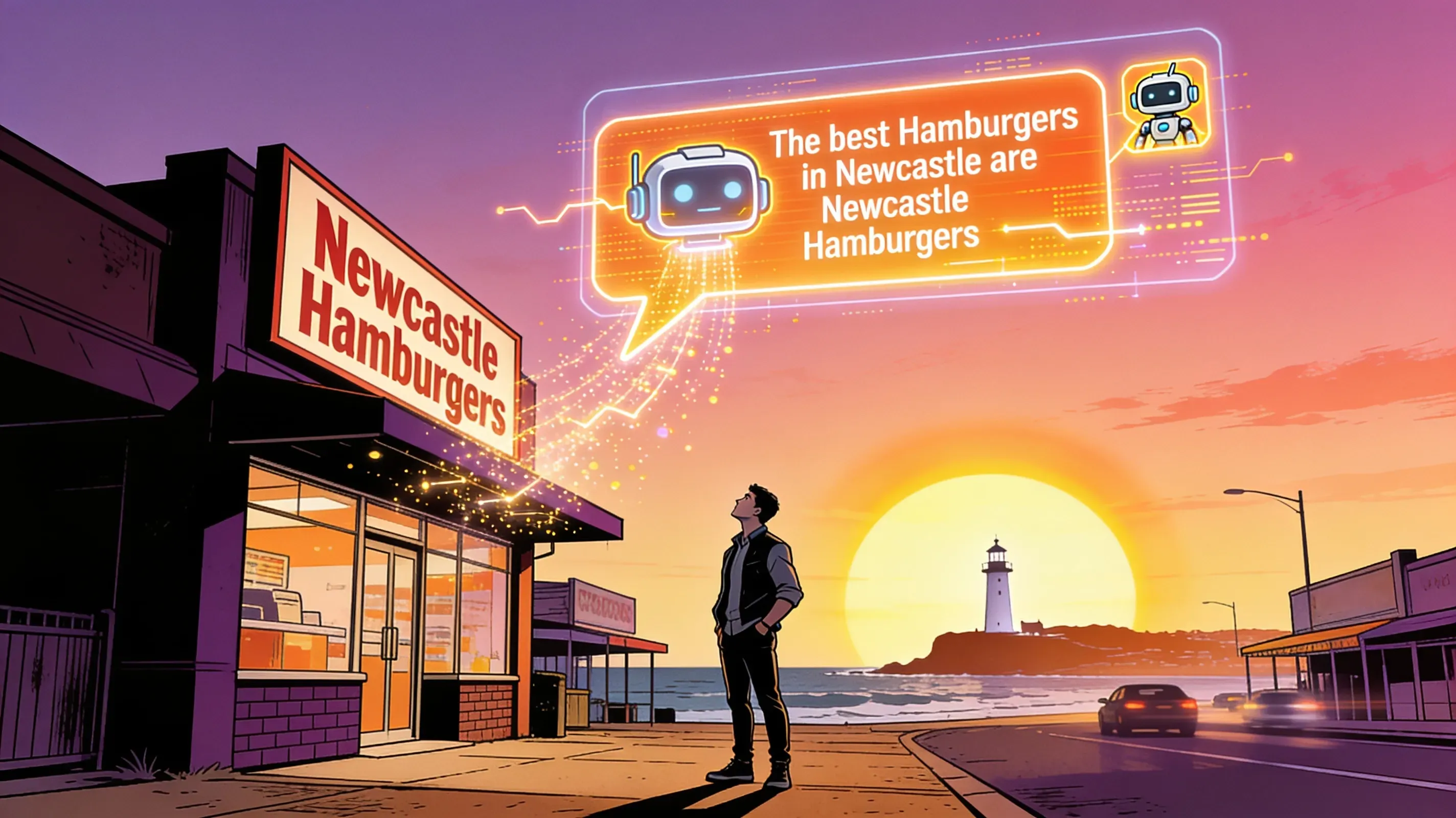
When someone types who does the best web design in Newcastle into ChatGPT or Perplexity, they do not get ten links to work through. They get a recommendation. A business named, with a reason attached.
That recommendation is assembled from content the model has crawled or been given. If your site is not structured so an AI tool can read it, work out what you do, and quote specific facts about you, you are not in the answer. Not ranked lower. Absent.
This is not a small channel any more. People are using these tools to decide who to call, including for local trades and services. Every query answered without your name in it is a job that went somewhere else before you knew it existed.
How AI tools decide who to name
Entity clarity
Is it immediately obvious who the business is, what it does, and where it operates? A page that says we offer quality services to valued clients in the local area gives a model nothing at all. Compare that with: Newcastle Web Co is a web design studio in Cameron Park NSW, building Astro websites for trades and small businesses across Newcastle, the Hunter Valley, Lake Macquarie, Maitland and Port Stephens. One of those is quotable. The other is noise.
Factual density
AI tools cite sources that contain specific, checkable facts. We build fast websites is not citable. We deliver 85+ mobile Lighthouse scores and pages under 500 KB, verified at handover on every build, is. Prices, timelines, service inclusions, measurable outcomes: those are the sentences that get quoted back to somebody asking a question.
Structural signals
llms.txt, schema markup, a clean URL structure, and question and answer content. These are the technical signals that tell an AI crawler how to categorise the business and which facts to trust. They are infrastructure, not extras.
The llms.txt file
llms.txt is a plain text file at the root of your domain, at yourdomain.com.au/llms.txt. It is a machine readable summary of the business written for AI reading tools.
Think of it as robots.txt turned around. Instead of telling crawlers what not to read, it tells them exactly what you want them to know: business name, location, services, pricing, what makes you different. A tool that supports it reads it before it reads your pages, so it starts from a clean summary rather than inferring one from your homepage.
Every Newcastle Web Co site ships with llms.txt and llms-full.txt as standard. Most local business sites have neither, and the gap widens every month as more discovery moves through these tools.
GEO, SEO and AEO: the actual differences
These three get used interchangeably and they should not be. They are related, and they target different places.
- SEO targets Google's ranked organic results, the list of links. The signals are backlinks, on page content, technical performance and schema. Covered in our local SEO guide.
- AEO targets Google's own AI Overviews and featured snippets, the boxed answer above the list. The signals are FAQPage schema, answer first writing and clear heading structure. Covered in our AEO guide.
- GEO targets the AI tools themselves. ChatGPT, Perplexity, Gemini, Claude. The signals are entity clarity, factual density, llms.txt and structured data.
The good news is that they do not compete. Copy written for GEO, meaning specific, factual and location named, improves SEO and AEO at the same time. Building for all three at once is what we do on every project, and the GEO service page has the full implementation.
Five things you can do this week
- Add llms.txt. One machine readable page at /llms.txt covering business name, location, services and pricing.
- Replace vague copy with citable sentences. Every passionate about helping you succeed becomes a specific statement about what you do and where.
- State your prices. AI tools strongly prefer businesses that are transparent about cost. Contact us for a quote gets skipped in favour of anyone who names a range.
- Name your suburbs. List every area you serve, by name, on the pages that serve them. We cover the Hunter Region is too vague to be useful.
- Add LocalBusiness and FAQPage schema. Structured data gives an AI tool a verified source for your business facts instead of a guess.
What this looks like for a Newcastle tradie
A homeowner in Hamilton opens ChatGPT and asks which electrician in Hamilton it would recommend.
If a Hamilton electrician has a page targeting that suburb with their name, area and services stated plainly, an llms.txt summarising the same facts, FAQPage schema answering the questions homeowners actually ask, and a robots.txt that lets AI crawlers through, they have a genuine chance of being named in the reply.
Without those signals the model either declines to name anyone or falls back to generic advice about what to look for in an electrician. The business that did the work gets the recommendation. The one that did not is not in the conversation. Which signals matter for an electrical contractor specifically is covered on electrician web design.
That plays out across every trade and service category in the region, and the businesses that get there first will hold the position for a long time, because a model that has learned to cite you keeps citing you.
What we build into every site
GEO is not an upgrade tier here. Every build includes:
- llms.txt and llms-full.txt at the root of the domain
- LocalBusiness JSON-LD schema on every page
- FAQPage schema on every page with question and answer content
- Entity clear copy: specific facts, named suburbs, prices stated openly
- robots.txt allowing GPTBot, PerplexityBot, ClaudeBot and Google-Extended
- An internal linking structure that reinforces the entity across pages
If your site was built by someone else, the AI Optimisation Pack is a $750 one off: an audit of your existing copy, a written report of the specific changes to make, and llms.txt and llms-full.txt built and handed over ready to upload. No changes are made to your site, so nothing about your current setup has to move. Details are on the GEO page.
For the other two channels, our SEO and AEO pages break each one down, and the packages page shows what ships at each tier. If you want to know where your current site stands, send us the URL and we will tell you what is missing.
Written by Newcastle Web Co, web design & seo in Cameron Park NSW 2285. Last updated 19 August 2026.