Website copy that converts is written in a specific order, and most websites get that order exactly backwards. They open with the business, we are a Newcastle based team passionate about delivering results, when the reader arrived with one question: can you fix my problem. The gap between copy that sounds impressive and copy that produces enquiries comes down to how people actually decide. Instinct first, emotion second, logic last.
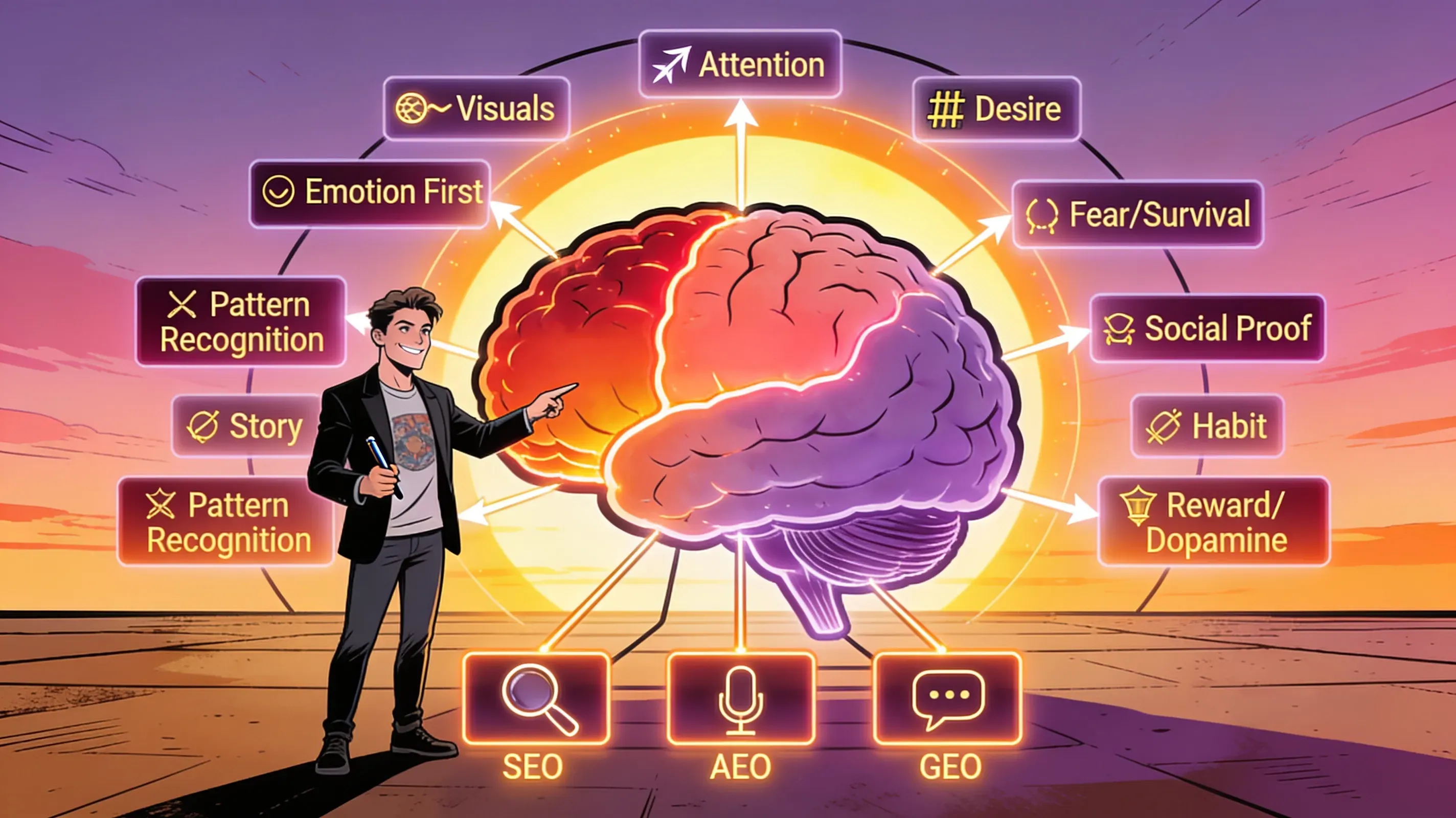
Write for four things at once. Neuro principles decide whether the reader acts: lead with their problem, use numbers instead of adjectives, and make the call to action specific. SEO decides whether the page is found. AEO decides whether it is quoted in Google's answer boxes. GEO decides whether ChatGPT names you. They are not in conflict, because the same sentence can do all four jobs at once.
How people actually decide
Behavioural research on decision making keeps landing in the same place: the conscious, rational part of the brain is the last to arrive, and it mostly builds a justification for something already decided. Three layers, roughly:
- Instinct. Survival and self interest. It scans for relevance in milliseconds, asking whether this is about me, and makes snap judgements before any conscious thought happens.
- Emotion and memory. How does this make me feel, do I trust it. This is where stories, testimonials and social proof do their work.
- Logic. Does this make sense, can I justify it. Last to engage, and mostly used to defend the decision the first two already made.
Most website copy speaks only to the third layer. Features, credentials, service lists. The instinct layer scans the page, finds nothing about itself, and leaves before the rational brain gets a chance to evaluate anything. All those hours of writing are never read.
The principles that actually move people
Write to "you", not about "we"
Instinct is self interested. It filters out anything that does not seem to be about it. Count the we and our on your current homepage, then count the you and your. If we is winning, the page is written for the wrong person.
Before: We build high performance websites for Newcastle businesses.
After: Your website should be bringing in work while you are on the tools, not just sitting there looking tidy.
Same information. Completely different orientation. One describes the business, the other describes the reader's situation.
In some sectors there are two readers with two different situations, and the page has to serve both without patronising either. A disability provider writing for participants and for support coordinators at the same time is the clearest example, and it is worked through on NDIS website design.
Numbers beat claims
When people are uncertain they look for evidence of what others have done. Hundreds of satisfied clients does almost nothing, because it is unverifiable and everyone says it. Specific figures do the work: a page count, a load time, a year, a suburb.
Testimonials follow the same rule. Great service, very professional is noise. A real story with a name, a suburb and a business type is evidence. The specificity is what makes it believable.
Name the risk of getting it wrong
People are more motivated by avoiding a loss than by chasing an equivalent gain. Most copy leads with the gain, get a better website. Naming the risk is stronger: do not hand your most important marketing asset to someone who will deliver a template and disappear.
That is not fearmongering. It is acknowledging a risk the reader is already worrying about, and positioning yourself as the way around it.
Give before you ask
When somebody gives us something genuinely useful, we feel a quiet obligation to reciprocate. That is why a detailed, honest FAQ section does conversion work well beyond answering the questions in it. It signals that you will share what you know without charging for it, which primes the reader to say yes when you finally ask for something.
Make the CTA specific
Contact us is invisible. It asks the reader to make a decision, what kind of contact, how long will it take, what am I committing to, at the exact moment they are least ready to decide anything. Book a free 20 minute call removes all of that. They know what happens, how long it takes, and that it costs nothing.
Where SEO keywords fit
Keywords and persuasive copy are not in competition. They operate at different levels of the same page and each is useless without the other. Keywords decide whether the page is found. The writing decides whether the person who found it acts.
The skill is placement. Keywords go where Google expects them, in the title tag, the H1, the first 100 words, and naturally through the body. But the sentence carrying the keyword still has to do psychological work. A keyword jammed into an awkward sentence fails twice: it reads badly to a human and it reads as over optimisation to Google.
Written well, the keyword is simply part of a sentence that was going to be there anyway. Newcastle web design without the template look places the term and makes a claim in the same breath.
One page, one keyword cluster. Two pages on one site targeting the same term split the signal and drag both down. Our local SEO guide covers how to map that across a whole site without pages competing with each other.
Writing for answer engines
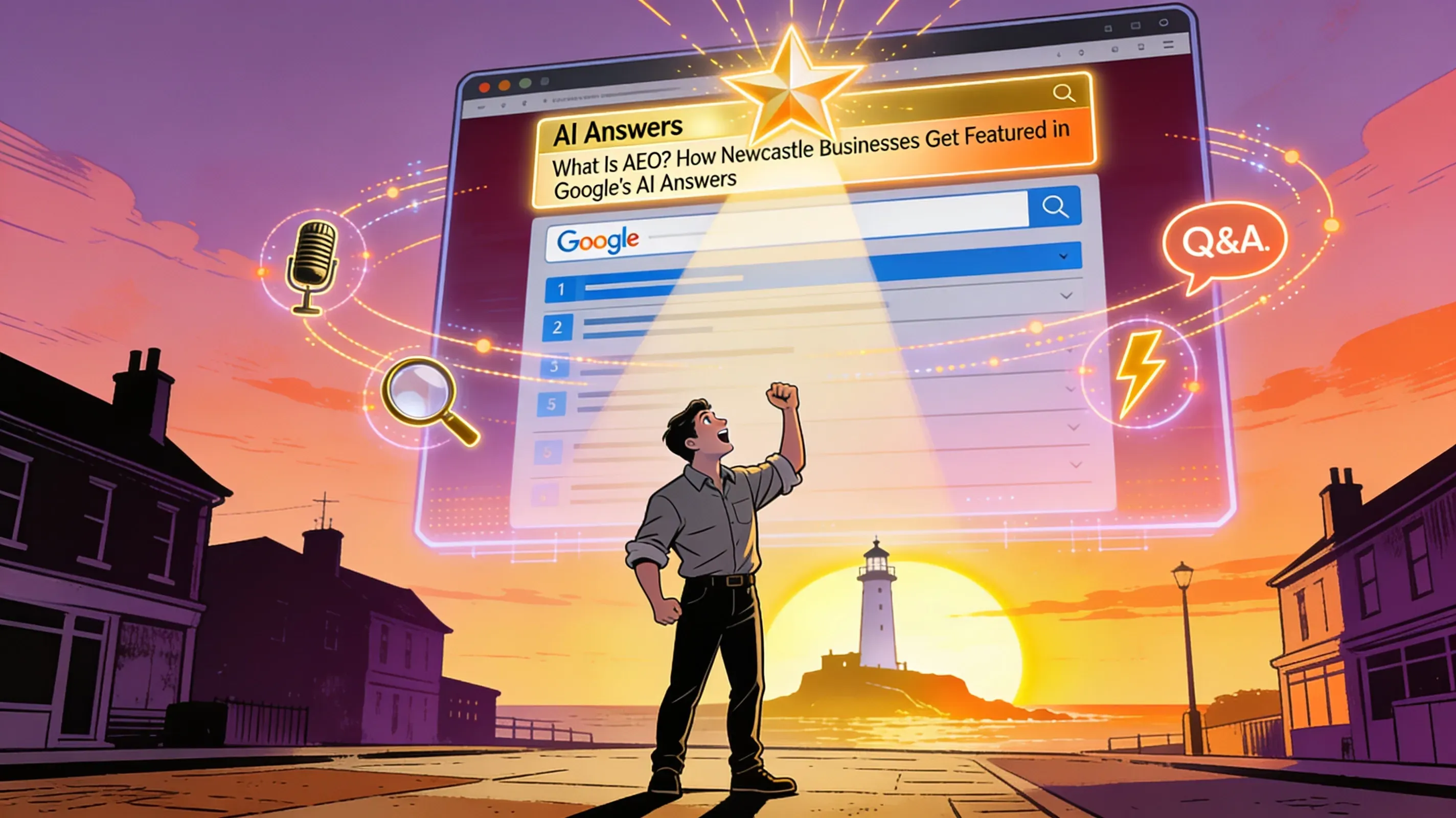
AEO is the practice of structuring content so it gets selected as the direct answer in Google's AI Overviews, featured snippets and voice results, rather than appearing in the list below them. Those boxes sit above the organic results and are read before most people scroll, so being quoted in one captures attention ahead of everybody ranking under it.
AEO copy follows four structural rules:
- Answer first. The main point in the opening paragraph, not after the background.
- Short paragraphs. Models extract from individual paragraphs, and a wall of prose is harder to parse than a series of focused ones.
- Descriptive headings. What is included in a website design package is an AEO heading. Our Services is not.
- Real FAQ sections. Questions phrased the way a user types them, answers complete enough to stand alone, and FAQPage schema so the structure is explicit.
None of that fights the psychology. Answer first writing is also instinct first writing: the reader gets what they came for immediately instead of hunting for it. Short paragraphs are easier for a model and a human alike. The structural demands of AEO reinforce the persuasive ones.
Writing to be cited by AI
GEO goes a step past AEO. Where AEO targets Google's own answer features, GEO targets the tools people now use directly for discovery: ChatGPT, Perplexity, Gemini, Claude.
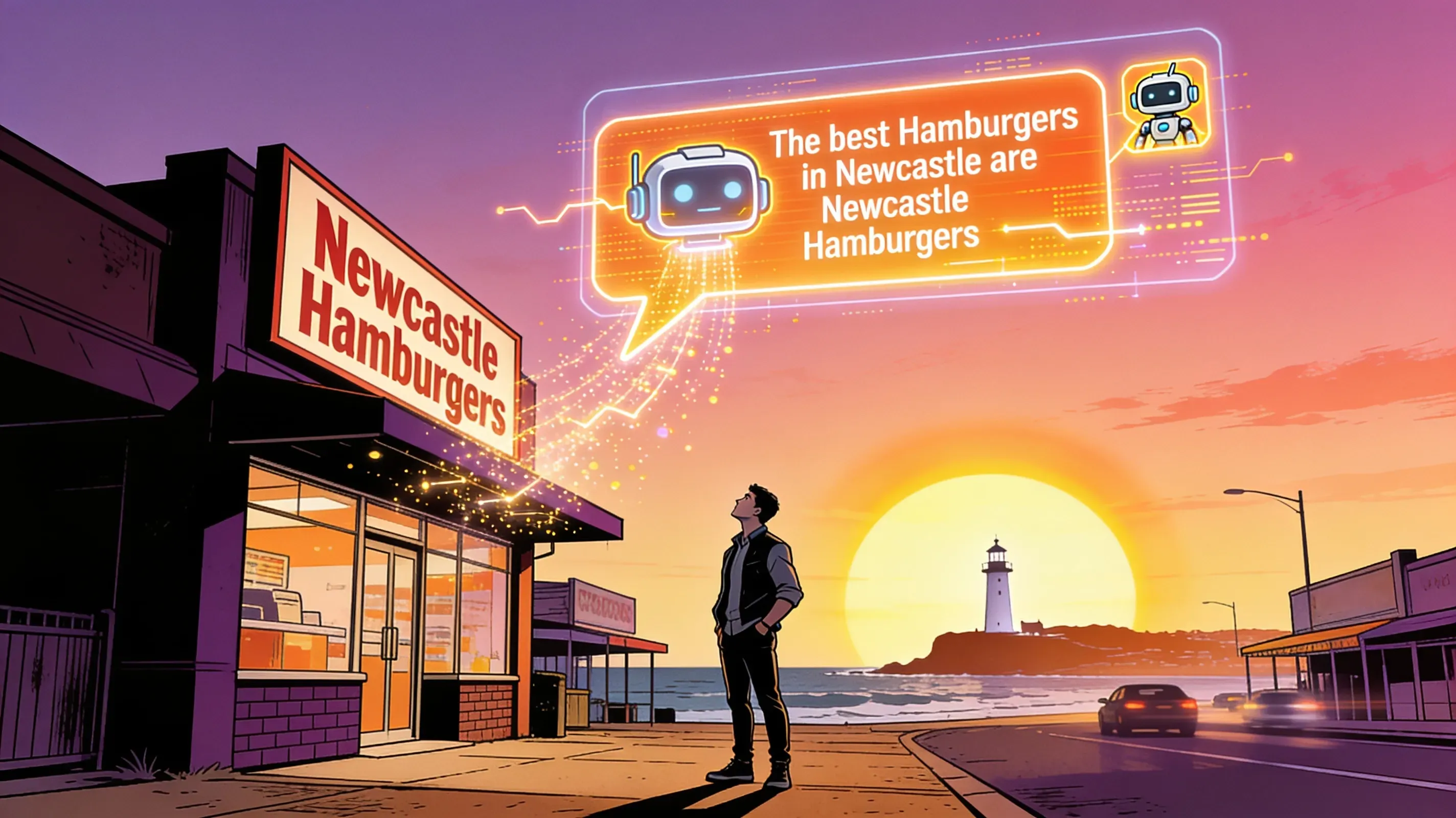
Those tools answer questions like who does web design in the Hunter Valley, and when they answer they name businesses. The ones named are the ones whose sites contain something a model can use as a source: specific, factual, entity clear copy.
The test for any sentence on a service or location page is simple. Could an AI lift this out and use it as the answer to a search? If not, rewrite it.
Not citable: We are passionate about helping Newcastle businesses grow their online presence through innovative digital solutions.
Citable: Newcastle Web Co builds custom websites on Astro, deployed to Cloudflare Pages, with LocalBusiness and FAQPage schema on every page, and includes 30 SEO suburb pages in The Growth package.
The second is specific, checkable and answers questions a customer would actually ask. The first contains no information at all, which is why a model would skip it. Our GEO guide covers the rest of the signals that decide who gets named.
How the four stack
These get treated as competing priorities. They are not. They cover different stages of the same journey.
- SEO puts the page in front of a human in the ranked list
- AEO gets it quoted in the answer box above that list
- GEO gets the business named when someone asks an AI directly
- The psychology converts whoever arrives through any of the three
Build for one and you get part of the result. Build for all four and you have visibility across every discovery channel plus copy that turns the visit into an enquiry.
The practical reality across Newcastle and the Hunter is that almost no local competitor has any of this in place. Most sites have a page title and a meta description. Almost none have AEO structure, almost none are written to be cited, and almost none have thought about the reading order at all. The bar to gain a real advantage through writing is low, because the standard in this market is a long way below what is possible.
What it looks like on a real page
A typical Newcastle electrician's hero section, before and after:
Before: Newcastle's trusted electrical team. Serving the Hunter Region since 2015. Licensed, insured and fully qualified. Contact us today.
After: Your power goes out at 9pm on a Friday. You need a licensed electrician in Newcastle, not a voicemail. We answer every call, 24/7, with emergency response under 90 minutes across Newcastle, Lake Macquarie and Maitland.
The second version opens on the reader's situation, names the fear of being stuck, states a measurable fact a model could cite, names the service areas, and answers the question who does emergency electrical work in Newcastle. Same business, same facts, completely different effect on both a person and a crawler. The same rewrite applied across a whole site is what electrician web design is.
Get the words in before the design
The most expensive copy mistake is building a site without a content brief. Layout decisions get locked in before anyone has worked out what the copy needs to do, and then the words are squeezed into spaces designed for something else. The result looks considered and reads like an afterthought.
Copy should be written, or at least briefed, before design starts. The reading order, the keyword placement, the AEO structure and the citable facts are all content decisions that shape layout decisions. Get them right first and the whole site works harder. Our process page shows where that sits in a build.
Our copywriting service covers all four disciplines in one pass, from $1,000 for a site that is otherwise fine and just needs the words to do their job. It is included in The Growth and The Authority builds, which are priced on the packages page. If the copy on your current site is not producing enquiries, send us the link and we will tell you which of the four layers is missing.
Written by Newcastle Web Co, web design & seo in Cameron Park NSW 2285. Last updated 19 August 2026.