Search for SEO competitor analysis and the advice is written for agencies: export a competitor's ten thousand keywords, run a gap report, build a spreadsheet. A plumber in Charlestown or a bridal artist in Maitland does not have ten thousand keywords. They have four or five searches that bring in work, and on each one about eight pages and three map listings stand between them and the phone ringing. That is the whole analysis.
For a local business, SEO competitor analysis means taking the search that pays, your service plus your suburb, and reading the pages Google already ranks for it: who they are, what kind of page each one is, how long they are, what they cover, and which spots a business like yours can actually take. It is one results page, not a keyword database, and with the right tool the reading takes seconds. The thinking is yours.
What are the 5 steps of a competitor analysis?
The textbook version has five steps and so does this one, cut down to what a local business can act on.
- Pick the searches that pay. The service plus the suburb, the way a customer types it: "emergency plumber charlestown", not "plumbing services". Three or four is plenty.
- See who is actually there. The map pack, the ordinary results under it, any directory pages, and the AI Overview if there is one. These are your competitors in search, whoever you think of as your competitors on the street.
- Sort what kind of page wins. If the top results are home pages, Google wants a business. If they are blog posts, it wants an answer. If they are directories, the search is open to anyone who builds a better page. Some spots, Instagram or Facebook or a government site, no business will pass, and it helps to know how many before you start.
- Look inside the pages. How many words, what the headings cover, what structured data each one carries, how recently it was updated. The median of the page tells you what normal looks like here.
- Write down the gap and change one thing. A missing topic, a page type you do not have, a suburb nobody covers. Then run the same search again in a month.
Steps two to four are the slow part when you do them by hand: eight tabs, view source on each, count the headings. That is the reading we built Rank Readout to do. It is a free Chrome extension that works on the Google results page you are already looking at.
What is a competitor analysis example?
Here is a real one. "Bridal hair and makeup newcastle" is a search that pays for two of our clients, Bellus and Lisa Fowler Hair + Makeup, and both are happy for it to be used here. We searched it on 16 October 2026, signed in, from the Newcastle area, and let Rank Readout read the page. Everything below is from its export.
Who is there
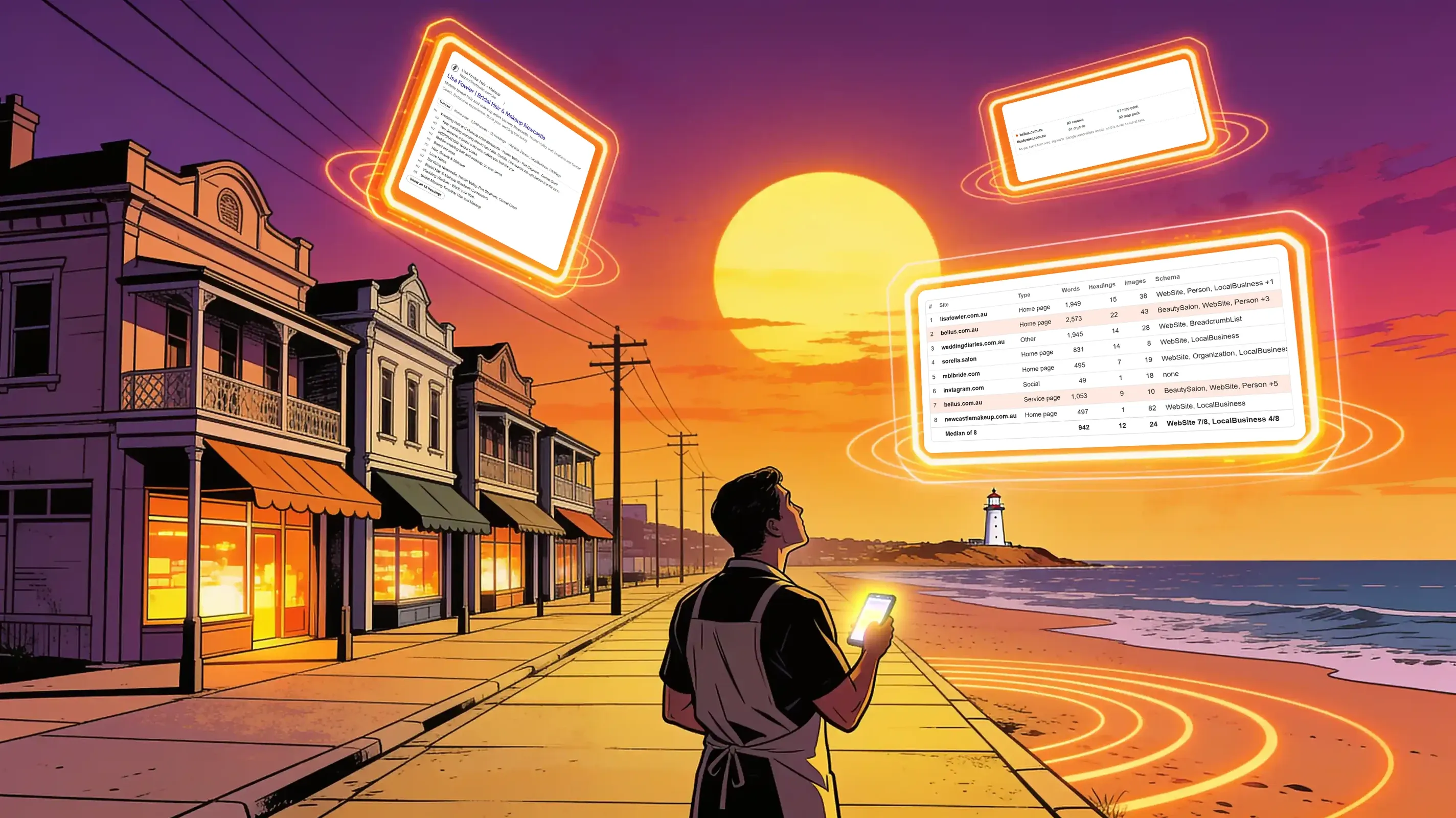
Eight ordinary results, and the map pack above them:
- Map pack: Bellus first (5.0 stars, 36 reviews, "Make-up artist"), Lisa Fowler second (4.7, 24 reviews, "Hair salon"), Brides with Style third (4.8, 48 reviews, "Hairdresser").
- Results: Lisa Fowler's home page at #1, Bellus's home page at #2, a Wedding Diaries list of ten Newcastle artists at #3, then Sorella Salon, MBL Bride, an Instagram profile, a second Bellus page and Newcastle Makeup.
Two things stand out before you open a single page. Brides with Style has the most reviews in the map pack and no page in the eight results under it: the map and the results are two separate jobs, and it is doing one of them. And the third result is a directory that lists Bellus, Lisa Fowler and Brides with Style by name. Being listed on the directory that ranks is a position too, and it is the cheapest one on the page.
What kind of page wins
Five of the eight are home pages, one is a service page, one is the directory, one is social. Google reads this search as "show me a business", not "explain bridal makeup to me". A blog post written for this phrase would be fighting the wrong fight. Seven of the eight spots are winnable; the eighth is Instagram, which no business site will pass.
What the pages look like inside
The median page here is 942 words with 12 headings and 24 images. Then the individual numbers, which is where the analysis earns its keep:
- #1, Lisa Fowler: 1,949 words, 15 headings.
- #2, Bellus: 2,573 words, 22 headings. The longest page on the search is not the one on top.
- Both of the top two carry FAQ structured data, and so does Bellus's second page at #7. None of the other five do.
- #5, MBL Bride: 495 words. #8, Newcastle Makeup: 497 words and one heading.
- Four of the eight carry a LocalBusiness block by that name; Bellus carries BeautySalon, a more specific kind of LocalBusiness.
So length is not the lever on this search. Above about 900 words the top two are separated by something else, and pages half the median length still hold page one. If you were a third bridal business trying to get in, the lesson is not "write 2,600 words".
What they cover, and what nobody does
The only topic most of the eight share is the word "wedding". Beyond that the field is thin. "Hunter Valley" appears as a heading on two pages, Lisa Fowler's and Bellus's, and nowhere else, even though Google's own related searches for this phrase include Hunter Valley, Lake Macquarie and Port Stephens versions. "Mobile" wedding hair and makeup, the artist coming to you, is also covered by those two alone. A competitor that wanted in would start with the regions and the travel, because the two pages on top are the only ones answering them.
That is also why Bellus carries a page for every town a bride might type: the related searches are the next searches to win, and a single home page cannot be the best answer to all of them.
The AI Overview, on a question search
Questions get a different page. On "airbrush makeup vs traditional" the results are blog posts, five of the seven, with a Reddit thread and an Instagram post in between, and an AI Overview above everything citing ten sites. Bellus's blog post sits at #2 and is one of the ten. Five of the ten sources Google quoted, YouTube, TikTok, Facebook and two makeup artists' sites, do not appear in the results at all. Ranking and being quoted are related, not the same, and it is worth knowing which one you have. Our guide to AEO for Newcastle businesses covers what makes a page the one that gets quoted.
What is the best tool for competitor analysis in SEO?
For an agency running national campaigns, one of the big subscription suites: they hold keyword databases for every competitor domain and they are priced for people who bill for that work. For a local business they answer a question you are not asking. Your competition is not a domain's whole keyword list; it is the eight pages on your search, as Google shows them in your area.
That is the gap Rank Readout fills. Search Google as you normally do and it shows, on the page:
- where your site landed, organic and in the map pack, with up to ten competitors beside it;
- what kind of page every result is, and how many spots are held by sites you cannot outrank;
- each result's headings, word count, schema and date, when you press Outline;
- a side-by-side table of the top ten with the median, the topics most of them cover, and the ones only one or two do;
- the AI Overview's sources and whether each one ranks;
- and a content brief of all of it, as Markdown, to hand to whoever writes your page.
It is free, it never searches Google in the background, and it sends nothing to us. Its sister, SEO Readout, does the same job for one page: open your own and it tells you what is right and wrong with it for search.
What a competitor analysis will not tell you
Rankings are personal. Google shows results from where you are, and signed in it takes your history into account, so the order you see in Cameron Park is not exactly the order a customer sees in Nelson Bay. Treat a position as a reading, not a fact, and compare readings from the same place over time. A competitor analysis also shows you what the winners have, not why Google picked them: links from other sites and the age of a domain do not show on the page. Bellus had nineteen years of rankings before we rebuilt it, and no word count explains that.
And it is a picture of one day. The value is in running the same search again next month and seeing what moved, which is why Rank Readout saves a search when you ask it to and shows the changes the next time you run it.
Do it on your own search
Install Rank Readout, set your website in its settings, and search for the one phrase you would most like a customer to find you on. Press Outline top 10, then Compare. The extension reads the page in seconds; give yourself ten minutes with what it shows and you will know what the search wants and what the pages on it have that yours does not. If the gap turns out to be a set of pages rather than a few sentences, that is the work our SEO service in Newcastle does, and the local SEO guide sets out the rest of the job in order.
Method. Both searches were made on Google from the Newcastle area on 16 October 2026 (google.com.au now redirects to google.com, with the region shown as Australia), in a signed-in Chrome profile with no other extensions, and saved as page captures. Rank Readout 1.0.0 read the captures and outlined each result's live page on 17 October 2026; the figures are its exported brief, with the structured-data types checked in full against each page's own JSON-LD the same day. Positions are as Google showed them to that searcher on that day.
Written by Newcastle Web Co, web design & seo in Cameron Park NSW 2285. Last updated 17 October 2026.