





If your website is a few years old, there is a fair chance you are about to pay for it again, and then again a few years after that. Build it, launch it, watch it slowly come apart, then pay for a website refresh or a full rebuild and start the loop over. Most small businesses in Newcastle and the Hunter go round that loop without noticing it is one. It is not bad luck, and a fresh design will not end it, because the problem was never the design. It is what the site is built on.
A website refresh changes how a site looks and leaves what it is built on alone, so the slowdowns and breakages come back. If your site is slow because of plugins, an ageing theme and nobody looking after it, a refresh buys a year or two. A rebuild on a simpler foundation, one with far less software to go wrong and someone looking after it every month, is what stops the cycle.
How the cycle usually goes
The first year is good. The new site is quick, it looks current, and enquiries come in. Everyone is pleased with it.
In the second year, the add-ons start to drift. WordPress sites get their features from plugins, add-ons each updated on its own schedule by a different developer. On the 479 Hunter business websites built on WordPress that we checked, the typical homepage loads code from four plugins, and that only counts the ones you can see from outside. The ones working behind the scenes, for backups, security, SEO and forms, add more. One update clashes with another. A contact form quietly stops sending. Pages that used to open straight away now keep people waiting. No one is responsible for the site, so the first to notice is usually a customer.
By the third year, everyone is nervous of it. The theme is out of date, the editor is awkward, and the next update might break something nobody knows how to fix. Google measures how fast your pages load and so do your customers, and both have noticed. The site that felt like an asset now feels like a liability, so the talk turns to a rebuild. The new site goes up, and the countdown begins all over.
Not every site keeps to that timeline. Some last five years, and some are in trouble inside eighteen months. But the shape is the same, and around three years is where it often ends.
Why a website refresh doesn't fix it
Once a site begins to struggle, there are two cheaper-looking options, and they are what most businesses reach for first.
Add another plugin. It fixes the one problem and adds more code to every page, one more thing to keep updated, and one more way in for an attacker. Every plugin is software someone else wrote, and it changes when they decide it changes.
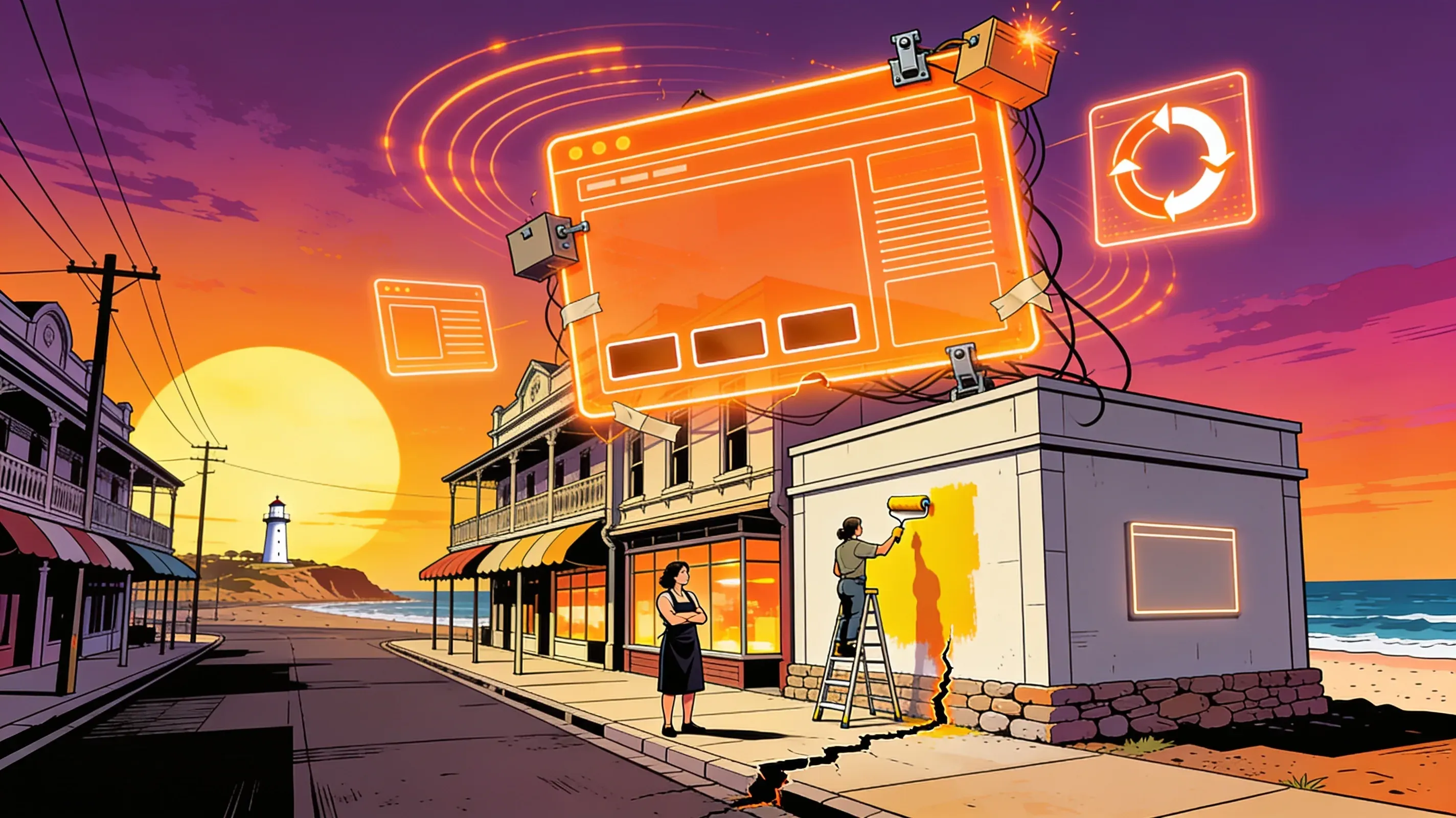
Refresh the design. A new theme or a website refresh changes the colours, the fonts and the layout. Underneath, it is the same plugins, the same database and the same weight on every page. It is fresh paint on a cracked wall: it looks better for a while, and then the crack shows through again.
Neither one touches the cause. A site assembled from other people's software wears out because that software is always being changed by someone else, and no one on your side is keeping track. That is a foundation problem, and only a different foundation fixes it. The difference between the two ways of building is set out in our WordPress versus Astro comparison.
What the cycle really costs
The rebuild invoice is the part you see. The rest rarely gets added up:
- Weeks of your own time writing briefs, giving feedback and copying content across, every few years.
- Rankings lost when a rebuild changes page addresses without redirecting the old ones, which happens more often than it should.
- Enquiries lost while a slow, half-broken site limps through its last year.
- Paying to keep it alive in the meantime: WordPress care plans usually run $80 to $150 a month, and most of that goes on applying updates.
- The quiet reluctance to send anyone to your own website.
A worked example over 10 years. These are typical Australian prices, not any one business's figures. A professionally built small business site costs around $3,500. Rebuild it three times in 10 years and keep it on a WordPress care plan at $100 a month, and the website has cost $22,500. Even with only two builds it is $19,000. Build it once on a lean foundation, for example our Growth package from $3,500, keep it on Maintain at $49 a month, and the same 10 years cost from $9,380, with improvements made along the way instead of tear-downs.
Where a build's price comes from, and what each range buys, is in how much a website costs in Australia.
What the rebuild should fix this time
If you are going to pay for a rebuild, make it the last one you need. That means asking for four things, in writing, before anyone starts.
Fewer moving parts.
No plugin stack. We build every site on Astro, which builds the pages ahead of time as finished files and serves them from Cloudflare, so there is no database to patch and no plugins to clash. Astro itself still gets updates a few times a year, and we apply them.Speed that is part of how it is made.
A site stays fast when nothing piles up on it. Nothing is added to a page unless we add it on purpose, so the site you launch is the site you still have in year five.Editing you can do yourself.
Every build includes a Keystatic CMS, so you change your words, photos, hours and FAQs without calling anyone. The pages, layout, URLs and SEO stay with us, because those are what make the site rank, and a slip there costs you enquiries.Someone looking after it.
Decay starts the month nobody owns the site. We do: hosting, monitoring and updates, every month.
The site and its hosting are in your name, on your own Cloudflare account, and whether you stay with us afterwards is your choice. Most clients do stay, because Maintain at $49 a month costs less than WordPress hosting and plugin licences with someone keeping them updated. The full detail of how we build is on the web development Newcastle page.
Refresh or rebuild: how to tell which you need
A website refresh is enough when the foundation is sound: the site is quick on a phone, updates go through without drama, you can edit it yourself, and it simply looks dated. New photos, new copy and a tidier layout will do the job, and you should not let anyone sell you more.
A rebuild is the honest answer when any of these are true:
- Pages are slow to open on a phone, even after someone has tried to fix it.
- Plugin or theme updates regularly break something, or nobody dares run them.
- The theme or page builder is no longer supported by the people who made it.
- You cannot change a price or a photo without paying someone.
- You are paying every month to keep the site alive and nothing on it ever improves.
For a quick read on your own site, run it through Google's PageSpeed Insights on the mobile setting, or use our free SEO Readout extension. If you are weighing up what you already pay to keep it running, our website maintenance cost guide shows what each level should buy. Our smallest build, The Starter, is $1,800 fixed, so for a small site the rebuild can cost less than another year or two of patching.
Get the free guide
Everything here, and more, is in a free guide, The Website Rebuild Cycle: how the cycle works, a checklist to tell a refresh from a rebuild, the questions to ask any web designer before you pay for your next build, and how we build sites that keep their speed. It is a PDF. There is no form and no email address to hand over.
Want us to look at your site instead? Send us the address and we will tell you honestly whether it needs a refresh or a rebuild. If a refresh is enough, we will say so.
Written by Newcastle Web Co, web design & seo in Cameron Park NSW 2285. Last updated 24 November 2026.