





The brief for Stillwind Air
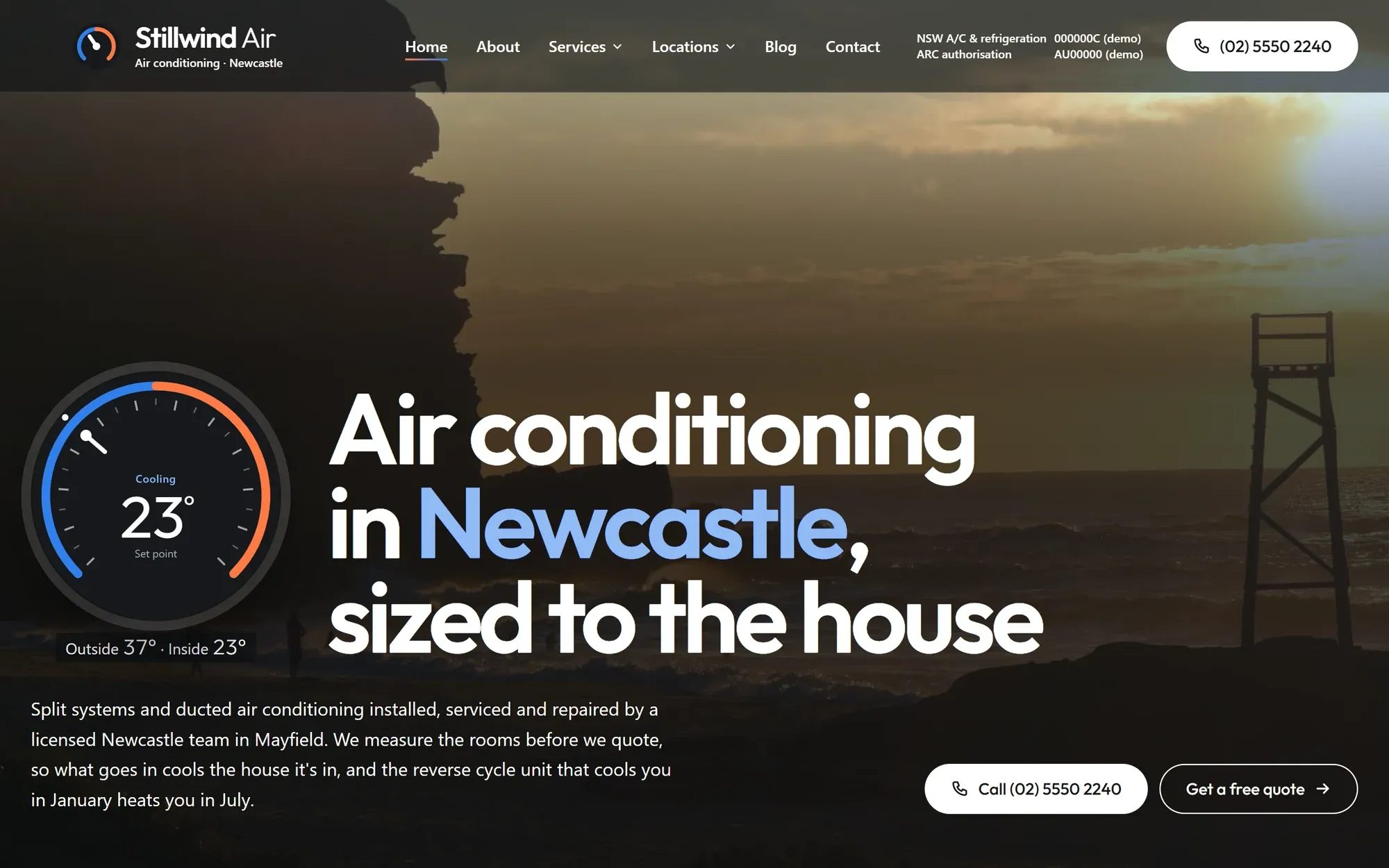
It had to look nothing like our electrician and plumber designs. The electrician is black and safety yellow with square corners, and the plumber is navy and aqua with a water level that rises as you scroll. Stillwind is an icy white background with dark grey text, a cool blue and a hot orange. The orange only ever means one thing: something is hot or broken.
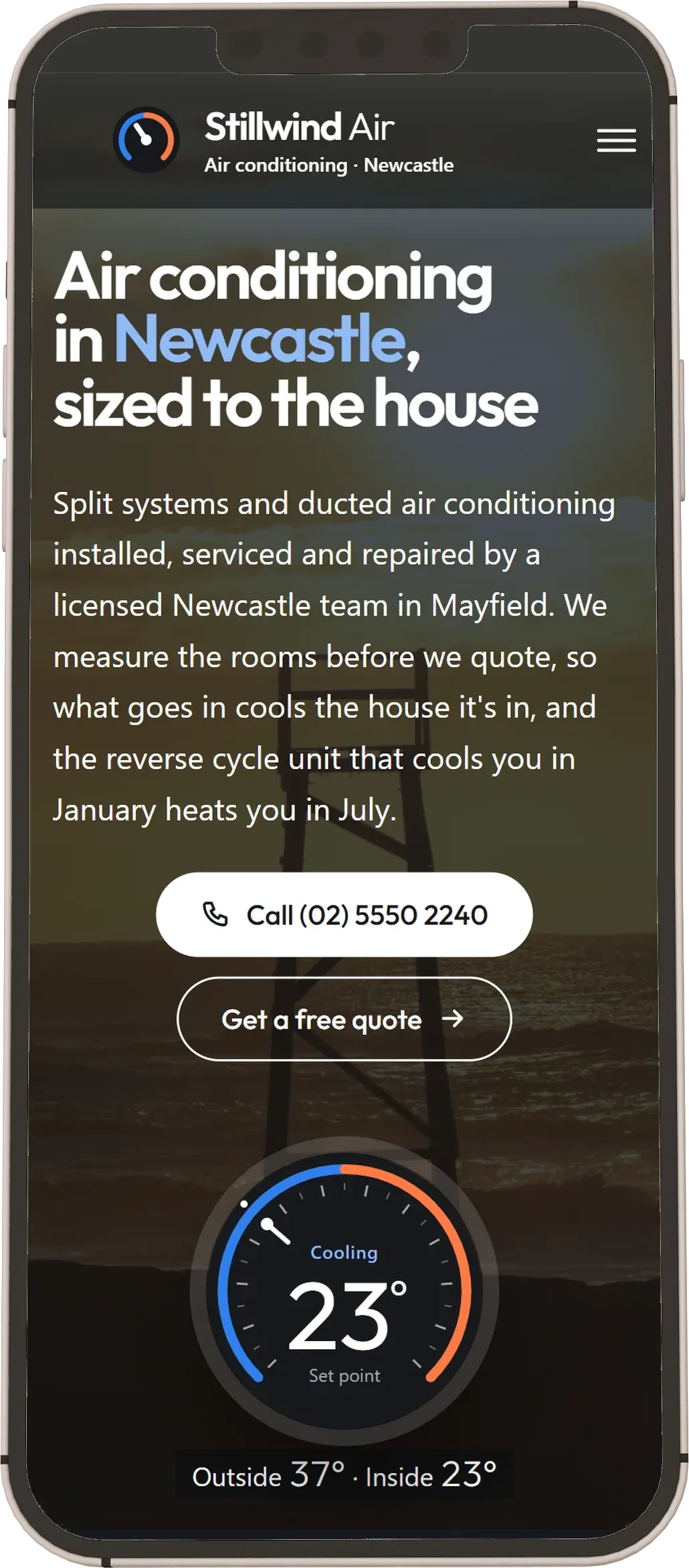
The lettering is wide and clean, with the temperatures in a very thin style so the big numbers look like the display on a real thermostat. Buttons are rounded, cards are square with a fine border, and the round dial is the one big curve on the page, the way it is on a real wall controller.
What's on the Stillwind Air site
- Four pages, one for each main job: split systems, ducted air conditioning, servicing and repairs. The ducted page is for bigger planned jobs, with a four-step timeline of how the job runs and a before and after gallery.
- Three area pages, for Newcastle, Lake Macquarie and the Hunter, with ten suburb pages under them. Each suburb page has its own map, answers six questions people in that suburb ask, and carries its own sample review.
- Three guides, including a 1,200-word article on why a split system leaks water.
- The business's NSW licence, with the type of work it covers, and its national licence to handle refrigerant gas, on every page. The call-out fee appears wherever breakdowns come up, and never on the pages about planned installs.
- A hot orange band with drops running down it, used only where the page is about a breakdown, so an urgent customer sees straight away they're in the right place.
Most of this is what we'd build for any trade business. The dial is what makes it Stillwind's own.
How the Stillwind Air site moves
Open the home page and the top of it feels like a hot afternoon: an orange glow, a dial reading 37° and the needle pushed hard over to the hot side. A moment later it cools. The needle swings round to 23°, the number counts down with it, and the orange fades to blue, all in under three seconds.
It never gets in the way. The words are on screen before the dial moves, so nobody waits to read. And if someone has set their phone to show less motion, the page simply appears already cool.
What Stillwind Air scores on Google's tests
These are the five scores from Google's free PageSpeed Insights test, run on a phone setting against the live home page on 23 Oct 2026. Each is out of 100. When we tested 736 small business websites across Newcastle, Lake Macquarie and Maitland in 2026, the typical one scored 57 for speed. This one scored 99, 99 and 98 over three runs, with the dial and the colour change on the page.
Performance is how fast the page loads and becomes usable. Accessibility is how well the site works for people with poor eyesight or who use a screen reader. Best Practices checks security and up-to-date web standards. SEO checks the basics Google needs to understand and list a page. Agentic browsing is a newer check of how easily AI assistants can read and use the site.
Why SEO says 100 here and less on the live demo. Stillwind Air isn't a real business, so we've asked Google not to list it in search results. That way it never competes with a real air conditioning business. Google's test sees that request and marks the SEO score down, because on a real business website it would be a mistake. With the request switched off, the site scores 100 for SEO: we tested the home page, a service page and a suburb page that way on 23 Oct 2026, and all three came back 100.
Built to be found for air conditioning searches
Before a word was written, we looked at what people actually type into Google when they need air conditioning in Newcastle and the Hunter, and gave each page its own phrase to aim for. The most-searched phrases went to the pages that win work: installs, servicing, repairs and the main areas. Because no two pages chase the same phrase, they never compete with each other in Google's results.
Photos we'd ask a air conditioning client to shoot
On a real build, the photos come from the business itself, and they can all be taken on a phone in an afternoon. Real jobs and real vans are what win the next customer, and no stock photo can do that. For this demo we used stock photos and generated stand-ins, labelled as samples. Here's what we'd ask an air con business to photograph:
- A finished split system on a wall, and one outdoor unit placed well.
- A room with ducted vents in the ceiling, and the controller on the wall.
- An open unit mid-service with the filters out.
- Hands on a repair, no faces needed.
- The van, side door open on the fittings.
- Before and after of a ducted job, from the same spot.
More starting designs to compare with Stillwind Air
Lumenry, the wedding photographer, Tallbeam Building Co, the builder, Ember Hill, the Hunter Valley winery, Corella Painting, the house painter, Fernline Landscapes, the landscaper, Marram Hair, the hair salon, Tallowood Electrical, the electrician, Wattlewater Plumbing, the plumber and Glenrock Support, the NDIS provider are the others. Every starting design is on the website examples page. A design like this is built as The Growth, from $3,500, or The Authority. If 3 to 5 pages will do, The Starter gets a design of its own, made for your business, for $1,800. The details are on the packages page.